
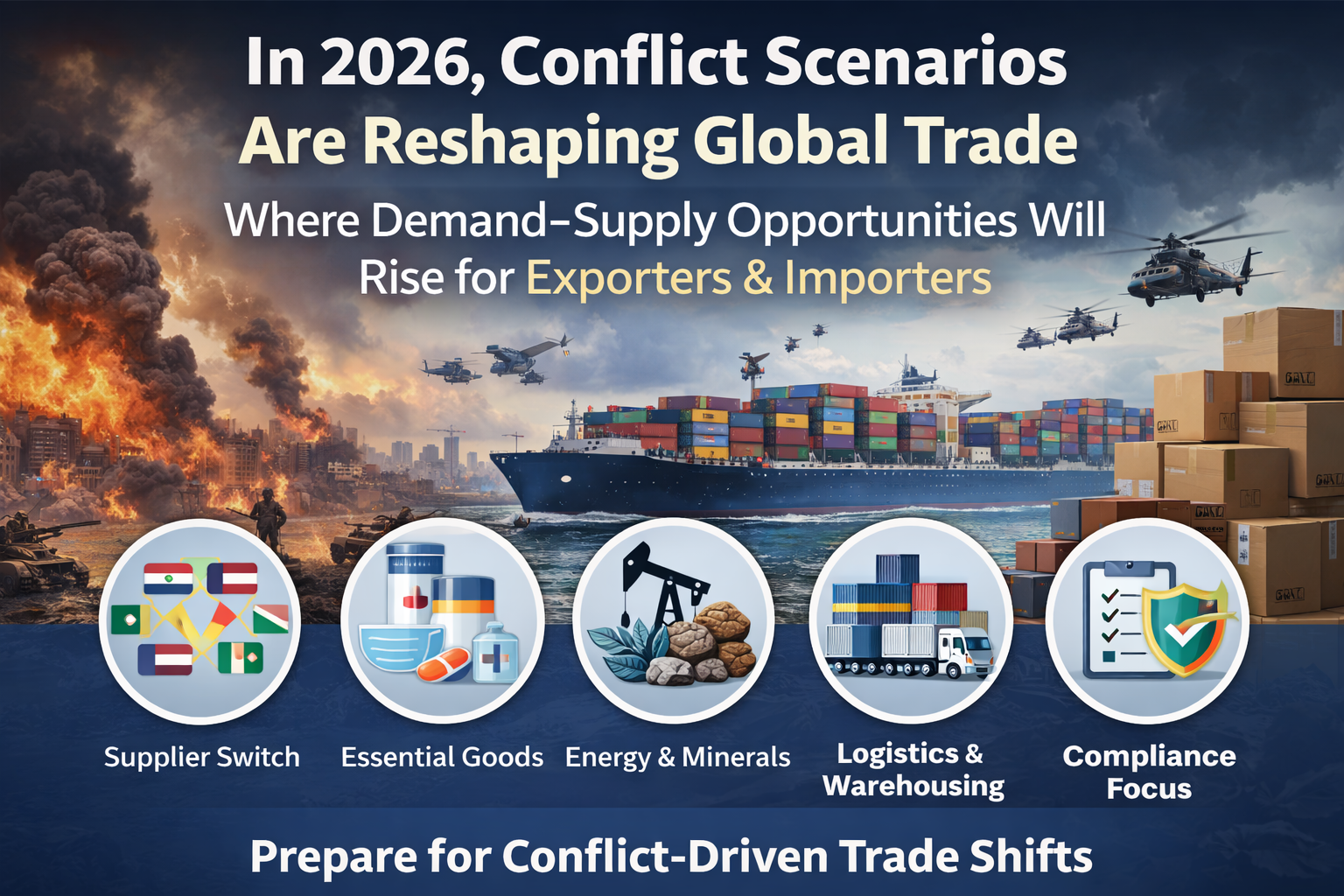
Demand–Supply Opportunities Will Rise for Exporters & Importers in 2026
In 2026, Conflict Scenarios Are Reshaping Global Trade: Where Demand–Supply Opportunities Will Rise for Exporters & Importers
Global trade in 2026 is moving through a “high-uncertainty” phase—where geopolitics, tariffs, and shipping disruption can change lead-times and landed costs overnight. International institutions have warned that growth is moderating and risks are tilted downward, while cooperation is weakening and trade barriers are rising.
At the same time, disruption always creates new trade corridors, urgent procurement needs, and supplier-switch opportunities—especially for exporters and traders who can deliver reliability, compliance, and faster execution.
This article explains the likely trade patterns under conflict scenarios in 2026 and highlights practical demand–supply opportunities across sectors.
1) Why “War Scenario” Matters to Export–Import (Even If You’re Not in the Conflict Zone)
Conflict risk affects trade through 5 big levers:
A) Shipping lane disruption and rerouting
When key routes become risky, vessels reroute—adding days/weeks, increasing fuel, insurance, and freight rates. Recent disruptions in/around the Red Sea showed how quickly volumes and transit patterns can collapse and costs rise.
B) Higher freight volatility and inventory shock
UNCTAD has highlighted increased volatility in freight rates and the risk of spillovers into major chokepoints.
C) Trade policy uncertainty (tariffs, controls, sanctions)
Businesses face “weaponisation” of supply chains and stronger scrutiny on sourcing and end-use.
D) Payment and counterparty risk
Banks tighten terms, insurance premiums rise, and buyers shift toward safer credit structures.
E) Buyer psychology changes
In uncertainty, buyers prioritize:
- continuity of supply
- stable landed cost
- proven compliance
- faster lead time
- multi-source strategy
2) 2026 Trade Reality: Slower Growth, Higher Friction, Stronger Services
The IMF projects global growth moderating into 2026, and the WTO has signaled a weaker outlook for merchandise trade versus services growth. This matters because goods trade becomes more selective, while services (logistics, repair, digital, consulting, compliance) become more in-demand.
3) Demand–Supply Opportunities That Rise During Conflict-Driven Trade Shifts
Below are the most common “surge zones” exporters and importers can prepare for.
Opportunity 1: Replacement sourcing (Supplier switch wave)
When traditional suppliers face delays, restrictions, or high freight, buyers look for:
- India / GCC / Southeast Asia / Latin America alternatives
- shorter routes or more stable ports
- suppliers with ready stock or fast production
What to sell: industrial components, engineering goods, spare parts, packaging materials, and maintenance consumables.
Opportunity 2: Essential goods and price-stable supply contracts
During uncertainty, essential categories remain resilient:
- staples & processed foods (long shelf-life)
- pharmaceutical inputs and basic medical supplies
- hygiene and sanitation products
Winning offer: fixed-price window, buffer stock program, reliable documentation, faster dispatch.
Opportunity 3: Energy-linked commodities and industrial minerals
Conflict pressure often increases risk premiums in:
- fuel and petro-linked products
- minerals and metals linked to manufacturing and energy transition
- substitute materials when a region becomes constrained
UNCTAD and other sources highlight how supply chains can become politically “weaponized,” especially for critical inputs.
Opportunity 4: Logistics, consolidation, and multimodal solutions
When routes break, trade doesn’t stop—it reroutes:
- new hubs for consolidation
- coastal feeder strategies
- rail/road alternatives where feasible
- “near-port warehousing” and inventory staging
Sell/offer: freight brokerage, consolidation, third-country routing compliance, end-to-end documentation support.
Opportunity 5: Compliance-first exports (documentation + traceability)
Buyers will pay more for suppliers who reduce risk:
- accurate HS classification
- origin clarity (COO)
- end-use statements where needed
- restricted-party screening
- dual-use awareness
This becomes a competitive advantage as trade barriers and scrutiny rise.
4) The Biggest Winners in 2026: Traders Who Build “Resilient Trade Systems”
If you want to capture demand in uncertainty, build these systems:
System A: Dual sourcing + backup suppliers
Create two options for:
- raw material
- packaging
- freight routes
- ports of exit
System B: Quote like a pro (landed cost resilience)
Always quote with:
- freight validity period
- fuel/war-risk surcharge clause (transparent)
- lead-time range (best + worst case)
- Incoterms clarity (avoid disputes)
System C: Use safer payment terms
Prefer:
- confirmed LC (where possible)
- DP/DA with insurance
- export credit cover
- staged payments for custom orders
System D: Build “fast proof” for buyers
Maintain ready:
- factory profile + capacity
- certifications
- test reports
- reference shipments
- standard export docs checklist
5) Action Plan: How Exporters Can Convert 2026 Disruption Into Orders
Week 1–2
- Identify 20–30 importers likely facing supply disruption (your product category)
- Create an “Emergency Supply Offer” PDF: lead time, MOQs, compliance, ports, Incoterms
Week 3–4
- Run a targeted LinkedIn + email outreach campaign:
- “Alternative supplier for X category”
- “Lead time guarantee + documentation-ready”
- “Trial order + fast dispatch”
Month 2
- Build a small inventory buffer for top SKUs
- Partner with 1–2 freight forwarders for route options