
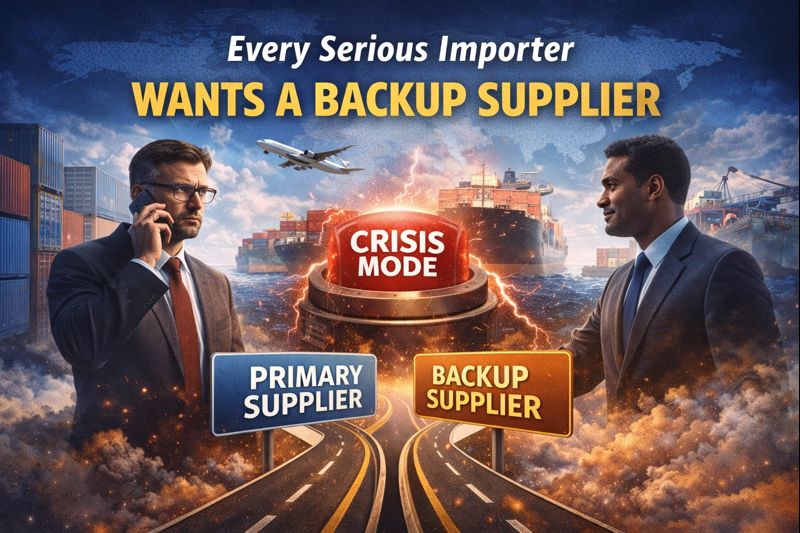
It’s True: Every Serious Importer Wants a Backup Supplier
In international trade, buyers may not always say it openly — but one truth remains consistent across markets, industries, and geographies:
This is not a theory. It is a practical survival strategy in global business.
Exporters who understand this reality build long-term success. Those who don’t often wonder why prospects stay silent — until suddenly they place a large order with someone else.
1. Global Trade Is Built on Risk Management
Importing is not just about buying products. It involves managing multiple risks:
- Supply disruptions
- Quality inconsistencies
- Shipping delays
- Currency fluctuations
- Regulatory and geopolitical changes
A single supplier, no matter how reliable, represents a single point of failure.
Experienced importers know this — and plan accordingly.
2. Why Importers Rarely Admit They Want Alternatives
Many exporters hear statements like:
- “We are happy with our current supplier”
- “We don’t want to change vendors”
- “Everything is running smoothly”
This does not mean the importer has no alternatives in mind.
In reality, buyers avoid openly discussing backup suppliers because:
- They don’t want to damage existing relationships
- They don’t want to signal dissatisfaction
- They prefer quiet preparation over public negotiation
Backup sourcing is done silently and strategically.
3. What Triggers the Need for a Backup Supplier?
Importers actively seek alternatives when they experience or anticipate:
- Repeated shipment delays
- Sudden price increases
- Capacity constraints at supplier end
- Quality complaints from their customers
- Seasonal demand spikes
- Tariff or trade policy changes
When these moments arise, importers do not start searching from scratch — they reach out to suppliers they already trust.
4. The Smart Importer’s Strategy
Professional importers typically maintain:
- 1 primary supplier
- 1 or 2 qualified backup suppliers
These backups may not receive regular orders, but they are:
- Pre-evaluated
- Technically approved
- Commercially understood
- Ready for quick activation
This strategy ensures business continuity — not vendor replacement.
5. Why Backup Suppliers Often Win Big Orders
Many large export contracts begin as:
- Emergency shipments
- Trial orders
- Short-term gap solutions
Once a backup supplier proves:
- Reliability
- Speed
- Professionalism
They often become:
- A parallel supplier
- Or, over time, the primary supplier
Some of the strongest export relationships in the world started as “just a backup.”
6. What Exporters Get Wrong About This Reality
Many exporters mistakenly believe:
- If no immediate order comes, the opportunity is dead
- Buyers only want the cheapest price
- Persistence means repeated follow-ups
In reality:
- Buyers observe behavior over time
- Professional restraint builds trust
- Value communication beats price chasing
Aggressive selling often removes you from the backup list.
7. How Smart Exporters Position Themselves
Successful exporters don’t try to replace suppliers.
They position themselves as:
- Risk-mitigation partners
- Reliable alternatives
- Capacity support providers
- Long-term collaborators
They say, implicitly:
“If you ever need support, we are ready.”
That message resonates globally.
8. The Exporter’s Long Game Advantage
Export marketing is not about closing every lead immediately.
It is about being remembered at the right moment.
Exporters who understand the backup-supplier mindset:
- Build stronger pipelines
- Close higher-value orders
- Create resilient international businesses
They don’t chase buyers — they stay relevant.
Conclusion: Backup Suppliers Are Not Secondary Players
In global trade, backup suppliers are:
- Strategic assets
- Risk buffers
- Growth enablers
If you are professional, patient, and consistent, you are not “just another exporter.”