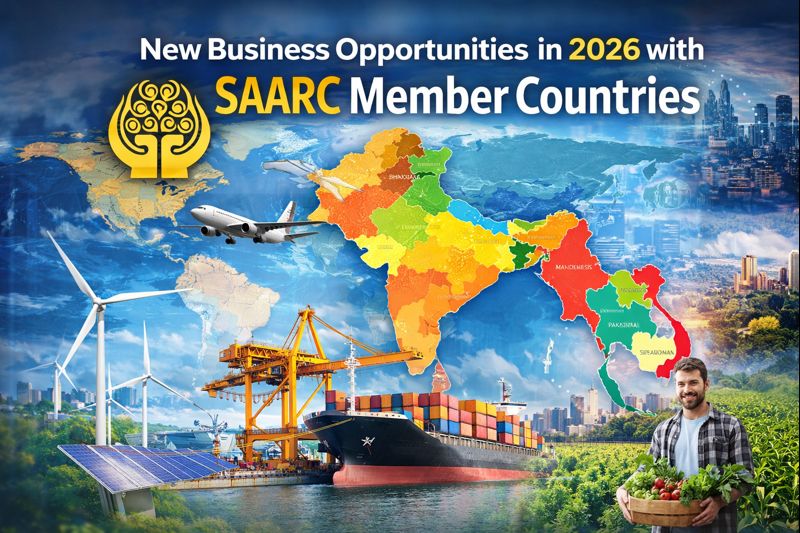
New Business Opportunities in 2026 with SAARC Member Countries
A New Decade for South Asian Growth
As the world pivots toward regional resilience and sustainable growth, 2026 marks a turning point for the South Asian Association for Regional Cooperation (SAARC). The bloc — comprising Afghanistan, Bangladesh, Bhutan, India, Maldives, Nepal, Pakistan, and Sri Lanka — represents nearly one-fourth of the world’s population and a combined GDP exceeding USD 4 trillion.
Today, the SAARC region is entering a new phase of digital integration, clean energy transition, and trade revival. For entrepreneurs, investors, and policymakers, this decade offers unparalleled opportunities to shape a more connected and prosperous South Asia.
1. Digital Transformation & Cross-Border E-Commerce
South Asia’s digital economy is expanding rapidly, driven by high mobile penetration and rising fintech adoption.
- India and Bangladesh lead the charge in digital payments and e-commerce logistics.
- Nepal, Bhutan, and Sri Lanka are modernizing customs and payment gateways to support cross-border online trade.
💡 Opportunity: Build regional e-commerce ecosystems integrating logistics, fintech, and regulatory harmonization — enabling small businesses to sell seamlessly across SAARC borders.
2. Renewable Energy Collaboration
Energy interdependence is set to define regional cooperation in 2026.
- Bhutan and Nepal’s hydropower capacity can fuel neighboring economies.
- India and Bangladesh are investing heavily in solar and wind projects.
- Green finance, carbon credits, and cross-border energy grids are now mainstream.
💡 Opportunity: Launch joint-venture renewable energy platforms to fund and manage sustainable power projects across SAARC nations.
3. Infrastructure, Connectivity & Trade Corridors
Modern connectivity projects are knitting South Asia together.
- The BBIN Motor Vehicle Agreement is revolutionizing road transport across India, Nepal, Bhutan, and Bangladesh.
- Maritime and rail corridors between India, Sri Lanka, and Maldives are cutting transit time and costs.
- Industrial parks and logistics hubs are opening new avenues for trade and manufacturing.
💡 Opportunity: Invest in integrated logistics, cold storage, and smart infrastructure to support regional trade flow and industrial diversification.
4. Healthcare, Pharma & Biotech Synergy
The post-pandemic world has reaffirmed healthcare as a shared priority.
- India’s pharmaceutical industry, combined with Bangladesh’s generics and Sri Lanka’s logistics, forms a strong healthcare value chain.
- SAARC nations are now collaborating on telemedicine, vaccine R&D, and health data infrastructure.
💡 Opportunity: Create SAARC Health Innovation Hubs focused on biotechnology, diagnostics, and health-tech startups.
5. Agritech & Food Processing Transformation
Agriculture remains a cornerstone of the SAARC economy.
- Emerging agritech firms are digitizing supply chains and improving yields.
- Food processing in Pakistan, India, and Bangladesh is attracting export-oriented investment.
- Organic and sustainable farming is gaining regional and global attention.
💡 Opportunity: Develop regional agritech accelerators and cross-border food processing clusters to enhance export competitiveness.
6. Tourism, Culture & Regional Branding
Tourism is rebounding strongly, supported by digital visas and joint promotional campaigns.
- The Buddhist Circuit linking India, Nepal, and Sri Lanka is witnessing growing spiritual tourism.
- Eco-tourism and heritage tourism are becoming major contributors to GDP.
💡 Opportunity: Build a SAARC Unified Tourism Framework — shared marketing, digital travel platforms, and multi-country tourist passes.
Summary
The SAARC region is poised for a renaissance — one driven by innovation, integration, and inclusivity. The coming years will reward businesses that look beyond borders and invest in regional value chains.
In 2026 and beyond, South Asia’s greatest advantage will not be its population or resources — but its ability to collaborate. Entrepreneurs, investors, and leaders who act now can shape the most dynamic and cooperative decade in SAARC’s history.