
EU Amends Its Generalised Scheme of Preferences (GSP) Rules — What You Need to Know (2026–2028)
On January 1, 2026, the European Union (EU) implemented significant changes to its Generalised Scheme of Preferences (GSP) — a cornerstone trade policy designed to help developing countries access the EU market with lower or zero tariffs. These amended rules will remain in force through December 31, 2028, reshaping trade dynamics for beneficiary countries and global exporters alike.
What Is the GSP?
The Generalised Scheme of Preferences is the EU’s preferential trade system that allows eligible developing and least developed countries to export certain products to the EU at reduced tariff rates. The aim is straightforward: promote economic growth, reduce poverty, and support sustainable development by facilitating easier access to one of the world’s largest markets.
Under the system, products receive preferential treatment — including lower duties vs. the standard Most Favoured Nation (MFN) tariffs that apply to other WTO members.
Key Changes in the 2026–2028 Amendment
The main update comes through Regulation (EU) 2025/1909, which modifies the list of products that are excluded from GSP benefits. These changes are a result of the EU’s periodic review process, which “graduates” highly competitive product categories out of preferential status if imports from a GSP beneficiary exceed set thresholds over time.
Effective January 1, 2026 – December 31, 2028:
🔹 GSP preferential duties will be suspended on a new list of products for certain beneficiary countries, including India.
🔹 These suspensions mean that products falling under the excluded sections will no longer enjoy reduced tariffs — instead, they face full MFN duties upon entering the EU market.
Which Product Categories Are Affected?
For India, the amended list of excluded sections under the GSP includes major export categories such as:
- Mineral products
- Organic and inorganic chemicals
- Plastics and rubber and related articles
- Textile materials
- Articles of stone, plaster, cement, ceramics and glass
- Pearls and precious metals
- Iron, steel and base metals
- Machinery and mechanical/electrical appliances
- Motor vehicles and transport equipment
(Note: specific sub-sections may vary by beneficiary country.)
These exclusions reflect sectors where exports have grown and become highly competitive, leading the EU to gradually phase out preferential access for products now deemed sufficiently competitive on their own.
Impact on Trade — Varying Perspectives
The effects of these changes depend on how analysts measure beneficiaries’ export profiles:
📌 The Indian Commerce Ministry has stated that the revised GSP rules will impact only around 2.66%–2.7% of India’s exports to the EU, focusing on tariff lines that were eligible under the previous GSP framework.
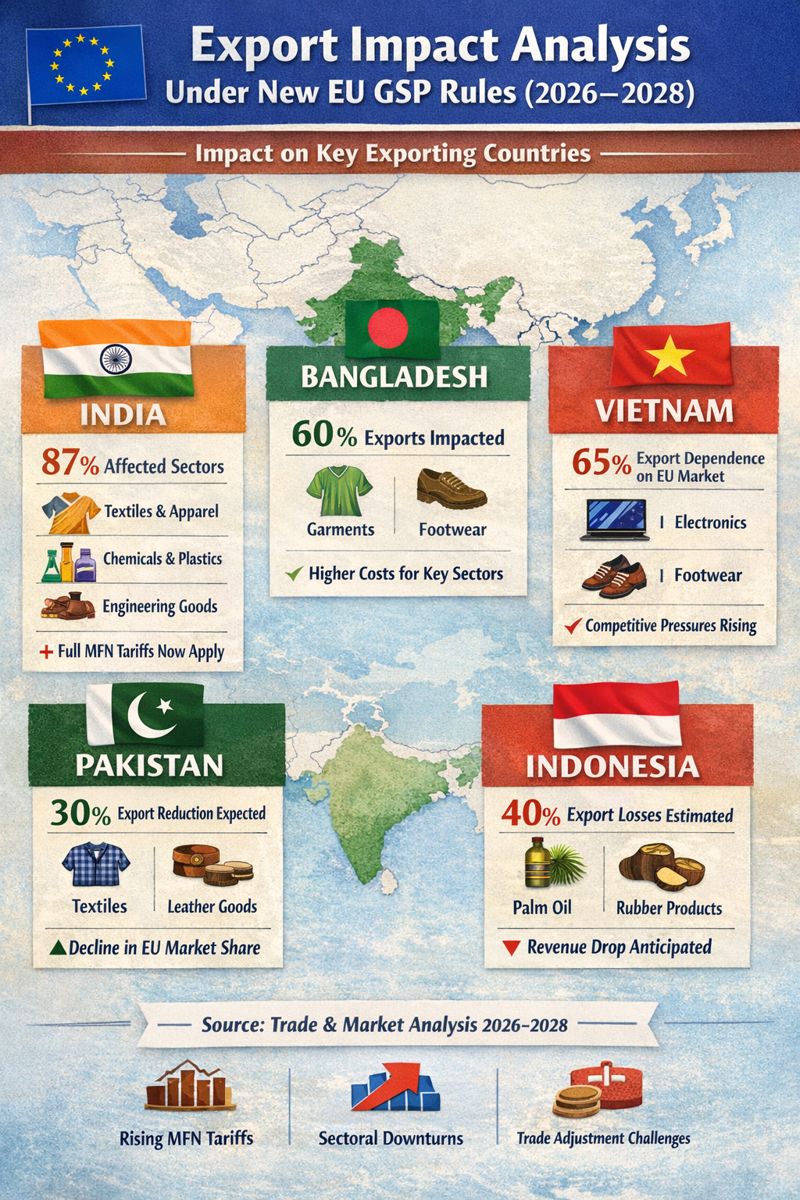
📌 Conversely, some trade think tanks and media reports claim that a much larger share — up to 87% of exports from countries like India — will face higher MFN tariffs for products that have graduated out of GSP immunity. Those include key sectors like textiles, chemicals, plastics and machinery.
These differing viewpoints stem from how export values are counted — whether measuring broad product categories or specific EU tariff lines that were eligible under GSP. Regardless, the structural shift is real and impactful for exporters, particularly in labor-intensive and industrial segments.
Why Is the EU Adjusting the GSP Now?
Several factors drive this adjustment:
✔ Graduation of Competitive Exports: Countries whose exports have become larger and more competitive are systematically phased out from GSP benefits for certain products.
✔ Evolving Trade Policy Goals: The EU continues modernising its trade preferences to align with sustainability, labour, and governance criteria, as outlined in broader GSP reviews.
✔ Encouraging Free Trade Agreements: By reducing dependency on unilateral preferences, the EU sometimes nudges countries toward negotiating bilateral or regional free trade agreements with more balanced market access.
What This Means for Exporters and Businesses
✔ Higher Tariffs on Many Products: Companies that previously enjoyed reduced duties must now factor in full MFN tariffs when pricing goods for EU markets.
✔ Competitive Pressure: Higher tariffs could tighten margins or reduce volume for certain sectors, especially if rivals in other countries retain preferential access.
✔ Opportunity for Negotiated Trade Deals: Many countries are using this period to pursue trade negotiations (like the India-EU FTA) in hopes of establishing stable, long-term tariff reductions beyond unilateral systems.
Looking Ahead
The amended GSP rules mark a transition point in the EU’s engagement with developing trade partners. While the aim remains to foster economic development, the reality is that rapidly growing exporters are being expected to stand on their own unless new preferential arrangements (like FTAs) replace the older scheme.
For exporters eyeing the EU market, the key takeaway is clear: plan now for a landscape with fewer unilateral tariff breaks — and more emphasis on negotiated and reciprocal market access.